




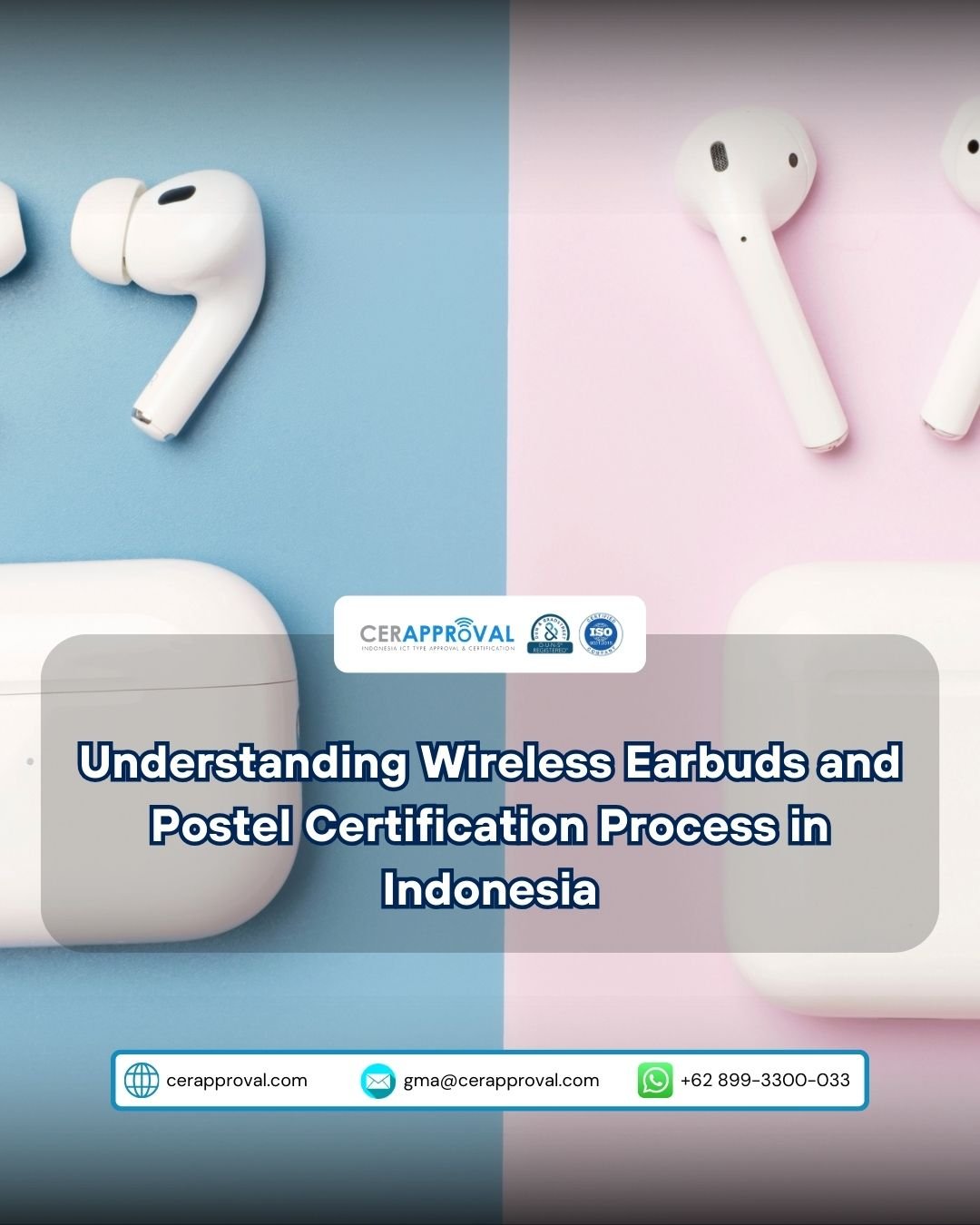
Wireless earbuds have rapidly become one of the most popular consumer electronic devices worldwide, including in Indonesia. Utilizing Bluetooth wireless technology, these devices fall under the category of telecommunications equipment. Therefore, before being distributed or sold in Indonesia, wireless earbuds must obtain Postel Certification (SDPPI Certification) issued by the Indonesian Ministry of Communication and Digital Affairs.
For manufacturers, importers, and distributors, understanding both the product characteristics and the certification process is essential to ensure legal market entry.
What Are Wireless Earbuds?
Wireless earbuds are compact, cable-free audio devices designed for listening and communication. They typically connect to smartphones, laptops, and other gadgets via Bluetooth technology operating in the 2.4 GHz frequency band.
Common features include:
- Bluetooth connectivity
- Built-in microphone
- Rechargeable battery
- Charging case
- Noise cancellation technology
Because they emit radio frequency signals, wireless earbuds are regulated telecommunications devices in Indonesia.
Why Is Postel Certification Mandatory?
Postel Certification ensures that:
- Devices do not interfere with other radio communications
- Radio frequency usage complies with national standards
- Consumer safety and network integrity are protected
- Products meet Indonesian regulatory requirements
Selling wireless earbuds without Postel certification may result in:
- Product recalls
- Administrative penalties
- Sales bans on e-commerce platforms
Regulatory Framework in Indonesia
Postel Certification is governed by:
- Ministry of Communication and Digital Affairs (Komdigi)
- Directorate General of Digital Infrastructure (DJID)
Wireless earbuds are classified as:
Bluetooth-based Short Range Devices (SRD)
Postel Certification Process for Wireless Earbuds
1. Document Preparation
Required documents typically include:
- Certification application letter
- Technical specifications
- User manual
- Product labeling
- Letter of authorization (for imported products)
- Company registration documents
2. Product Testing
The device must be tested at an SDPPI-accredited testing laboratory to verify:
- Frequency compliance
- Transmit power limits
- Electromagnetic compatibility
3. Submission to DJID
System
Test results (LHU) are submitted through the official certification system for technical evaluation.
4. Issuance of Postel Certificate
Once approved, the Postel Certificate is issued, allowing the product to be legally marketed in Indonesia.
Common Challenges in Certification
Businesses often face issues such as:
- Incomplete documentation
- Technical non-compliance
- Lengthy testing procedures
Working with a professional certification consultant significantly improves efficiency and approval success.
Postel Certification Services by Cerapproval
Cerapproval offers comprehensive services including:
- Regulatory consultation
- Laboratory testing coordination
- End-to-end Postel certification handling
- Transparent cost and timeline estimation
We help ensure your wireless earbuds enter the Indonesian market smoothly and legally.
Planning to sell wireless earbuds in Indonesia?
📩 Contact Cerapproval today for a fast, compliant, and hassle-free Postel certification process.
Want your device certified quickly and accurately?
Contact Cerapproval today for a free consultation and start your certification process!
- Get a free consultation for your certification.
- Download the complete guide to the KOMDIGI certification process.
- Schedule a meeting with the Cerapproval expert team today!
Contact Us Today:
🌐 www.cerapproval.com
📧 gma@cerapproval.com
📱 WhatsApp: +62 899‑3300‑033