




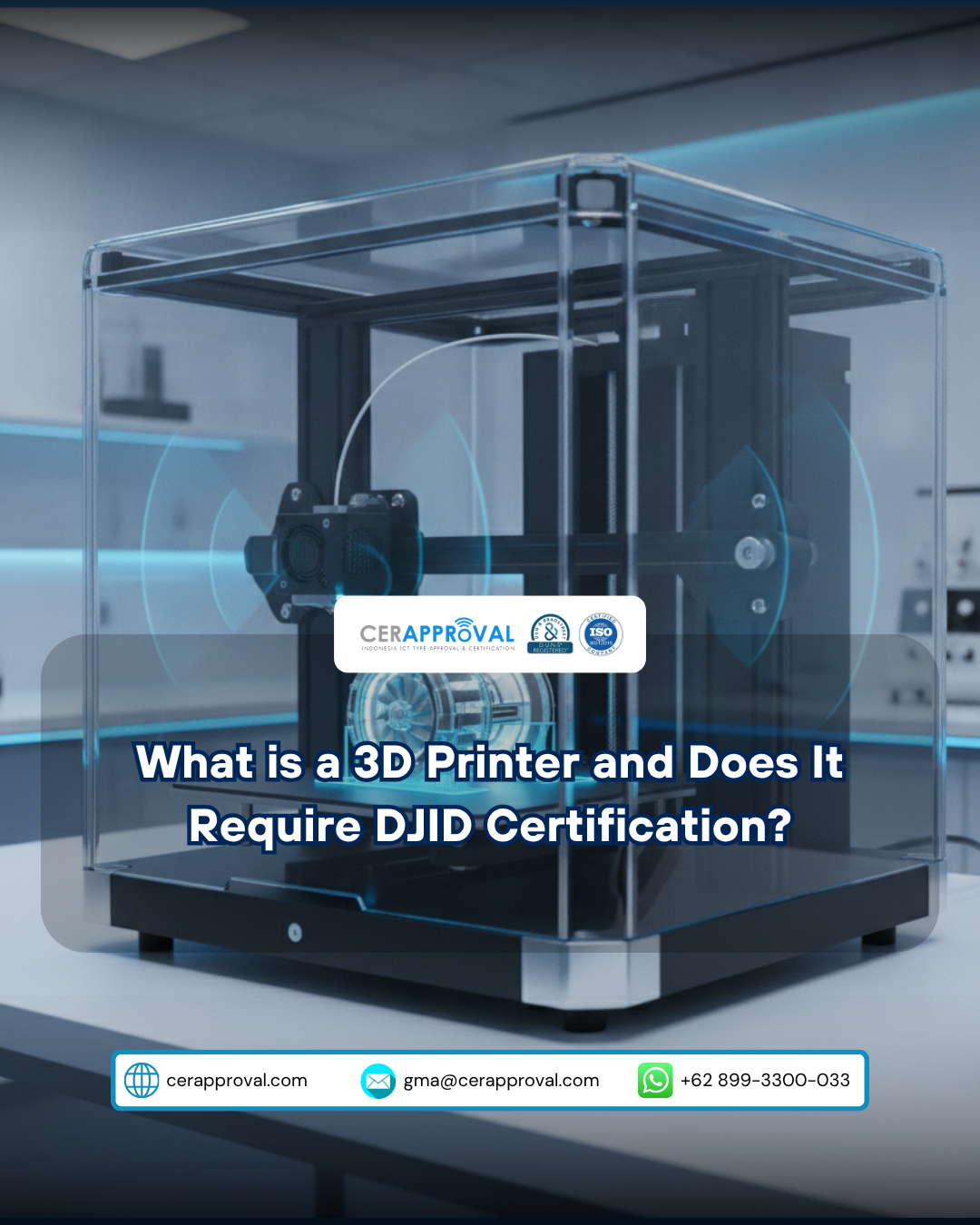
The rapid growth of digital manufacturing technology has introduced groundbreaking innovations, one of which is the 3D Printer. Unlike conventional printers that produce two-dimensional documents, a 3D printer creates physical three-dimensional objects directly from digital designs.
As the demand for 3D printers continues to grow in Indonesia, importers, manufacturers, and distributors often ask an important question:
Does a 3D printer require DJID (formerly SDPPI) certification before being sold or imported into Indonesia?
The answer depends on the communication features built into the device. Here’s everything you need to know.
What Is a 3D Printer?
A 3D Printer is a machine that produces three-dimensional objects from digital CAD files using a manufacturing process called additive manufacturing.
Instead of cutting material away, the printer builds an object layer by layer using materials such as:
- PLA
- ABS
- PETG
- Resin
- Nylon
- Metal
- Composite materials
Today, 3D printers are widely used across numerous industries, including:
- Manufacturing
- Healthcare
- Automotive
- Architecture
- Education
- Robotics
- Product Design
Why Do Electronic Devices Require DJID (SDPPI) Certification?
In Indonesia, electronic devices equipped with radio communication technology must comply with regulations issued by the Directorate General of Digital Infrastructure (DJID) under the Ministry of Communication and Digital Affairs (Komdigi).
The certification aims to:
- Ensure product safety.
- Verify compliance with Indonesian technical standards.
- Prevent harmful radio frequency interference.
- Ensure legal compliance before products enter the Indonesian market.
Does a 3D Printer Need DJID (SDPPI) Certification?
The answer depends on the printer’s connectivity features.
Many modern 3D printers now include wireless technologies such as:
- Wi-Fi
- Bluetooth
- Wireless LAN
- Other RF communication modules
Certification Is Required
A 3D Printer requires DJID certification if it contains wireless communication technologies such as:
- Wi-Fi
- Bluetooth
- RF Modules
- Other radio transmitters
These products must undergo laboratory testing and receive official DJID certification before they can be imported, distributed, or sold in Indonesia.
Certification May Not Be Required
A 3D printer generally does not require DJID certification if it operates solely through:
- USB connection
- SD Card
- Wired LAN (without wireless functionality)
and contains no wireless communication module.
Risks of Selling a 3D Printer Without DJID Certification
Importing or marketing a wireless-enabled 3D printer without the required certification may result in:
- Customs clearance delays or shipment detention
- Import rejection
- Administrative penalties
- Product recalls
- Legal sanctions under Indonesian regulations
Ensuring compliance before distribution helps businesses avoid costly delays and regulatory issues.
How to Obtain DJID Certification for a 3D Printer
The certification process generally includes the following steps:
- Review the product specifications.
- Identify wireless communication features.
- Conduct laboratory testing.
- Prepare and submit the required documentation.
- Undergo DJID technical evaluation.
- Receive the official DJID Certificate upon approval.
Working with an experienced certification consultant can significantly simplify the process and reduce approval time.
Conclusion
Not every 3D Printer requires DJID (formerly SDPPI) Certification in Indonesia.
If the printer includes wireless communication features such as Wi-Fi or Bluetooth, certification is generally mandatory before the product can be legally imported or marketed.
However, printers that operate exclusively through wired connections without any radio communication modules are generally not subject to DJID certification requirements.
Understanding these requirements early helps businesses avoid regulatory issues and ensures a smooth market entry into Indonesia.
Frequently Asked Questions (FAQ)
Does every 3D printer require DJID certification?
No. Only 3D printers equipped with wireless communication technologies such as Wi-Fi or Bluetooth generally require DJID certification.
Does a USB-only 3D printer require certification?
Generally, no. If the printer has no wireless communication module and operates only via USB or SD Card, DJID certification is typically not required.
What happens if I import a 3D printer without DJID certification?
You may face customs detention, import rejection, administrative fines, product recalls, or other legal consequences.
Who should apply for DJID certification?
Manufacturers, importers, distributors, and brand owners intending to market wireless-enabled devices in Indonesia.
Get Professional DJID Certification Assistance from Cerapproval
Planning to import or sell a 3D Printer in Indonesia?
Cerapproval provides end-to-end assistance for DJID (formerly SDPPI) Certification, helping businesses navigate regulatory requirements efficiently and professionally.
Contact us today for a FREE consultation!
🌐 www.cerapproval.com
📧 gma@cerapproval.com
📱 WhatsApp: +62 899-3300-033